


Empowering legal professionals
Make us your partner, to help you gain the competitive advantage you seek.
Make us your partner, to help you gain the competitive advantage you seek.
.png)
The legal profession in South Africa has a retention problem.
On average, the tenure for legal professionals is circa two years. Compare this to an industry like telecoms, which comes in at 5.2 years, and you can see just how significant the retention challenge has become.
Legal staff are voting with their feet at a rate barely matched anywhere else in the professional economy.
The cost of getting the employer choice wrong is not abstract. Data from legal wellbeing researchers estimate each departing attorney costs a firm up to R2.5 million once recruitment, lost billable hours, disrupted workflows, and client-continuity damage are factored in. Junior departures cost between R500,000 and R1.5 million each.
That is the employer’s loss.
But the candidate’s loss is years of stalled development, damaged confidence, and a CV pockmarked with short stints. This is harder to price.
My article identifies three toxic-employer types to watch out for.
This is the most dangerous and most underestimated category, precisely because these firms are small enough to escape the reputational scrutiny that larger institutions face.
The pattern is well-documented: a firm built entirely around one dominant personality - usually the founding partner - who cannot distinguish between the firm’s success and personal validation.
Reviews of comparable small, owner-run firms describe the pattern bluntly: “run by classic narcissists who are entitled, controlling, and petty micromanagers,” with “no personal accountability and little integrity” and “no HR and therefore no grievance system”.
Another small firm review captures the mechanics precisely: “the turnover rate for both attorneys and paralegals is high... After the first few weeks, you can expect gaslighting, yelling, and profanity. Expectations are hardly ever defined or communicated well”.
The structural reason this happens is simple and important to understand: research on narcissistic leadership shows that self-centred bosses devalue those around them, treating colleagues as either competitors or tools for manipulation. Workplaces led by such individuals experience higher turnover rates, lower morale, and frequent conflict.
In a large firm, HR, a managing partner committee, or a board provides some check on any one individual’s behaviour.
In a small owner-managed practice, there is no such circuit breaker - the founder IS the culture, the HR department, the appraisal system, and the final word on every dispute.
Crucially, these founders rarely recognise themselves as the problem: they experience high turnover as evidence that good staff are hard to find or the market is soft, not as feedback on their own conduct.
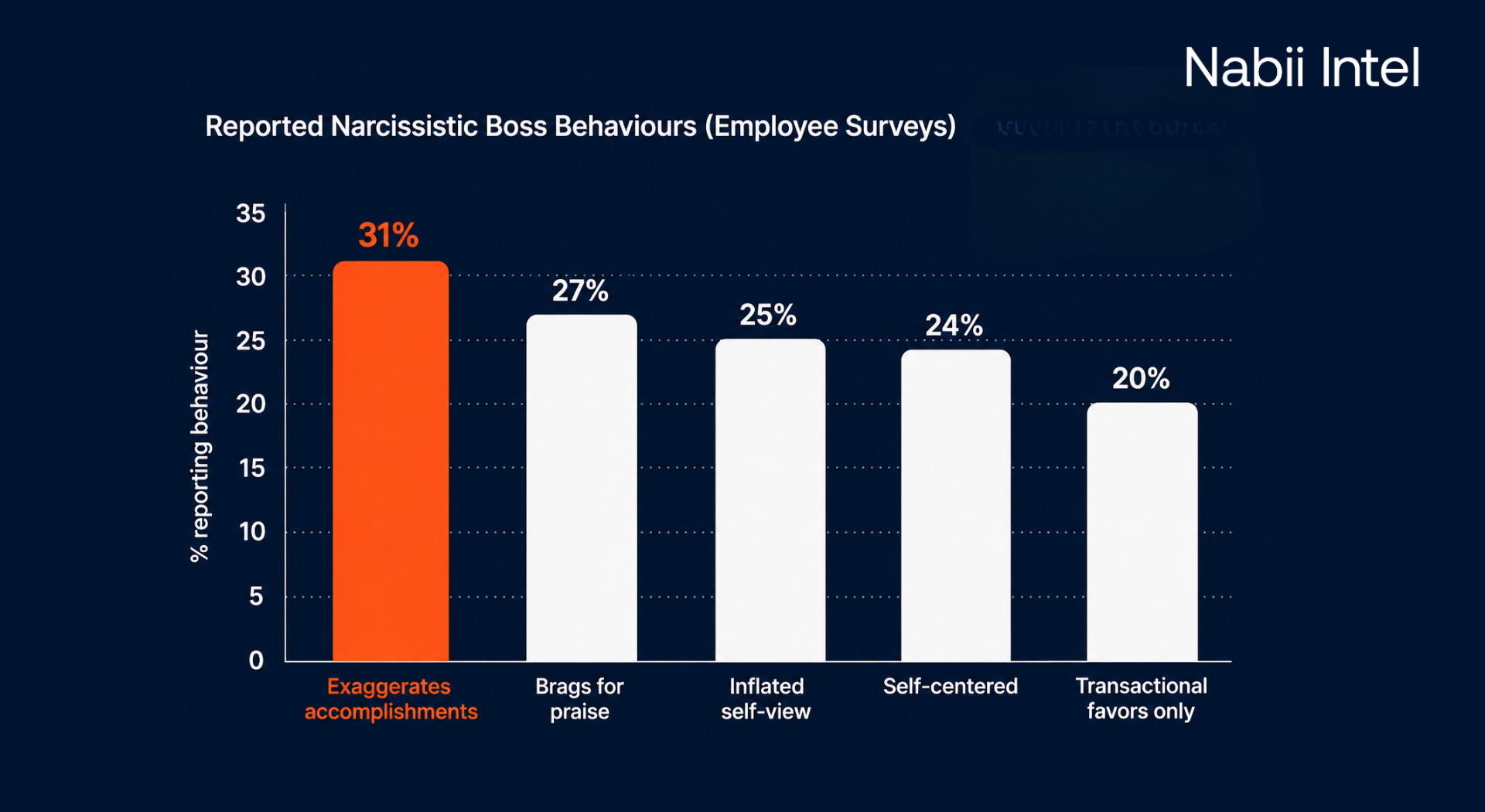
Employee survey data on narcissistic bosses shows roughly 20-30% of workers report a boss with clearly narcissistic tendencies affecting the workplace, with 31% saying their boss exaggerates accomplishments and 25% describing an inflated self-view.
The second archetype inverts the stereotype that in-house counsel roles are the safe, sane alternative to firm life.
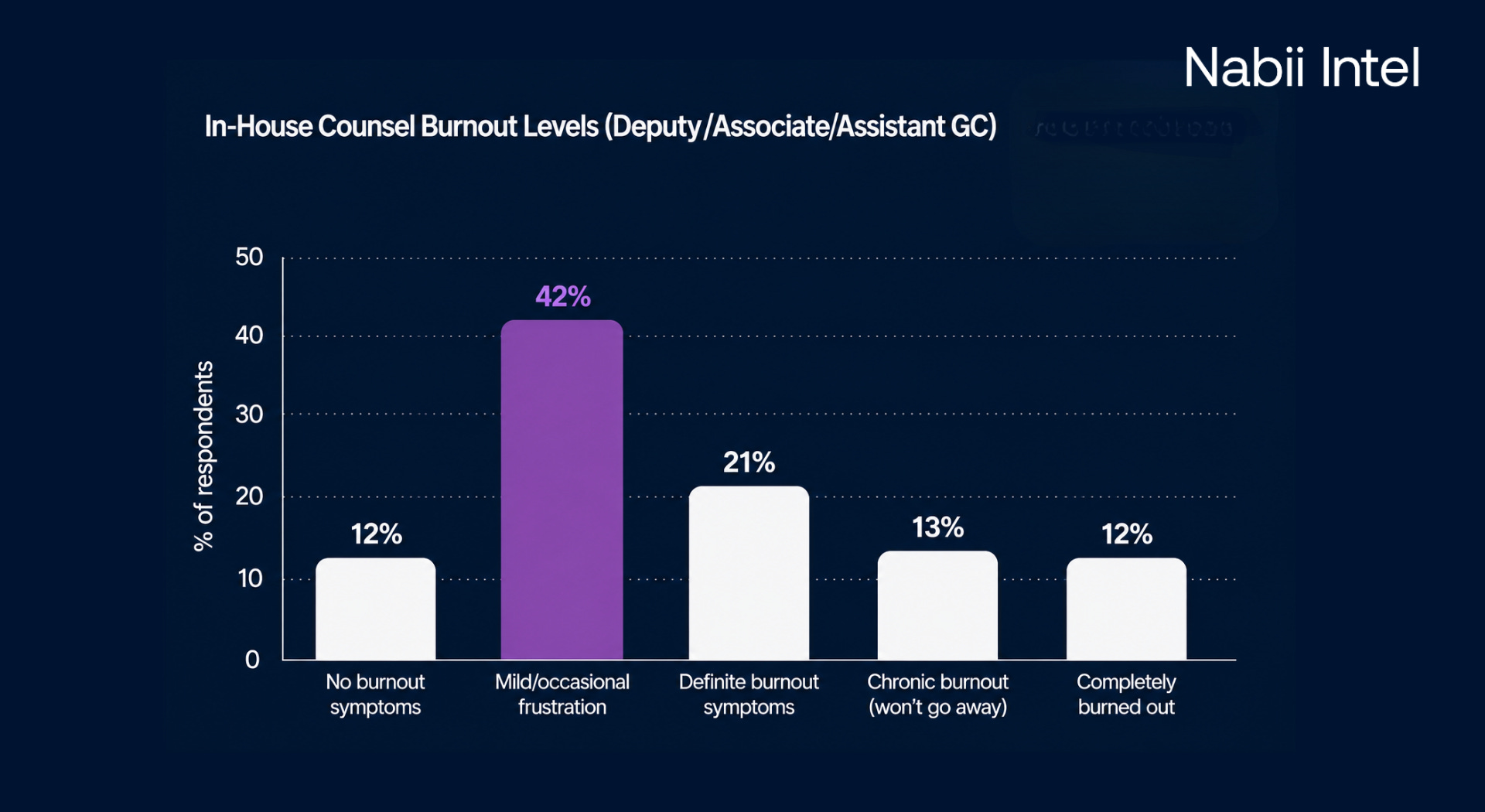
International survey data - the best available proxy given limited SA-specific in-house benchmarking - shows 97% of in-house counsel report some level of stress or burnout, with satisfaction down 12 points from 2022 and 71% wanting to leave the in-house track entirely, not just switch employers. Nearly 90% of in-house teams report attrition-related dysfunction, and of those affected, 9 in 10 are actively job-hunting within one to two years.
The damage concentrates at the mid-level - the associate and deputy GC layer that actually carries the department’s daily workload - where 55% report dissatisfaction and 70% are open to leaving, a mobility rate substantially higher than at the top of the department.
The Association of Corporate Counsel’s 2025 stress data reinforces this: professionals working 55+ hours a week are five times more likely to report high stress than those working under 45 hours, and 24% of highly stressed staff plan to leave within a year.
The toxicity here is structural rather than personality-driven: a GC or CLO who under-resources the team, refuses to push back on the business for realistic headcount, or tolerates an always-on culture creates the same churn and burnout outcomes as a bullying boss - just dressed in corporate language.
The third type is the larger firm - often prestigious on paper - that runs a deliberately Darwinian, high-billable-hour culture where junior staff are treated as disposable inputs rather than developing professionals.
UK regulator guidance on toxic law firm cultures explicitly lists the diagnostic markers: “high pressure ‘boiler room’ cultures,” “unreasonably high targets and heavy workloads,” “expectations of excessively long hours,” and “high staff turnover and poor mental health” as a package.
South African accounts of this dynamic describe candidate attorneys being deliberately overloaded with conflicting deadlines from multiple partners, then criticised regardless of the outcome - a pattern one South African legal commentator described as being “carefully orchestrated” to break confidence and enforce compliance.
Academic research published in the South African Law Journal confirms this is not anecdotal: the International Bar Association’s 2019 global report flagged a disturbing trend of bullying within the legal profession both internationally and in South Africa specifically, and local labour law offers only indirect remedies; unfair discrimination claims under the Employment Equity Act, constructive dismissal claims, or unfair labour practice claims; none of which is a quick or accessible fix for a junior candidate attorney.
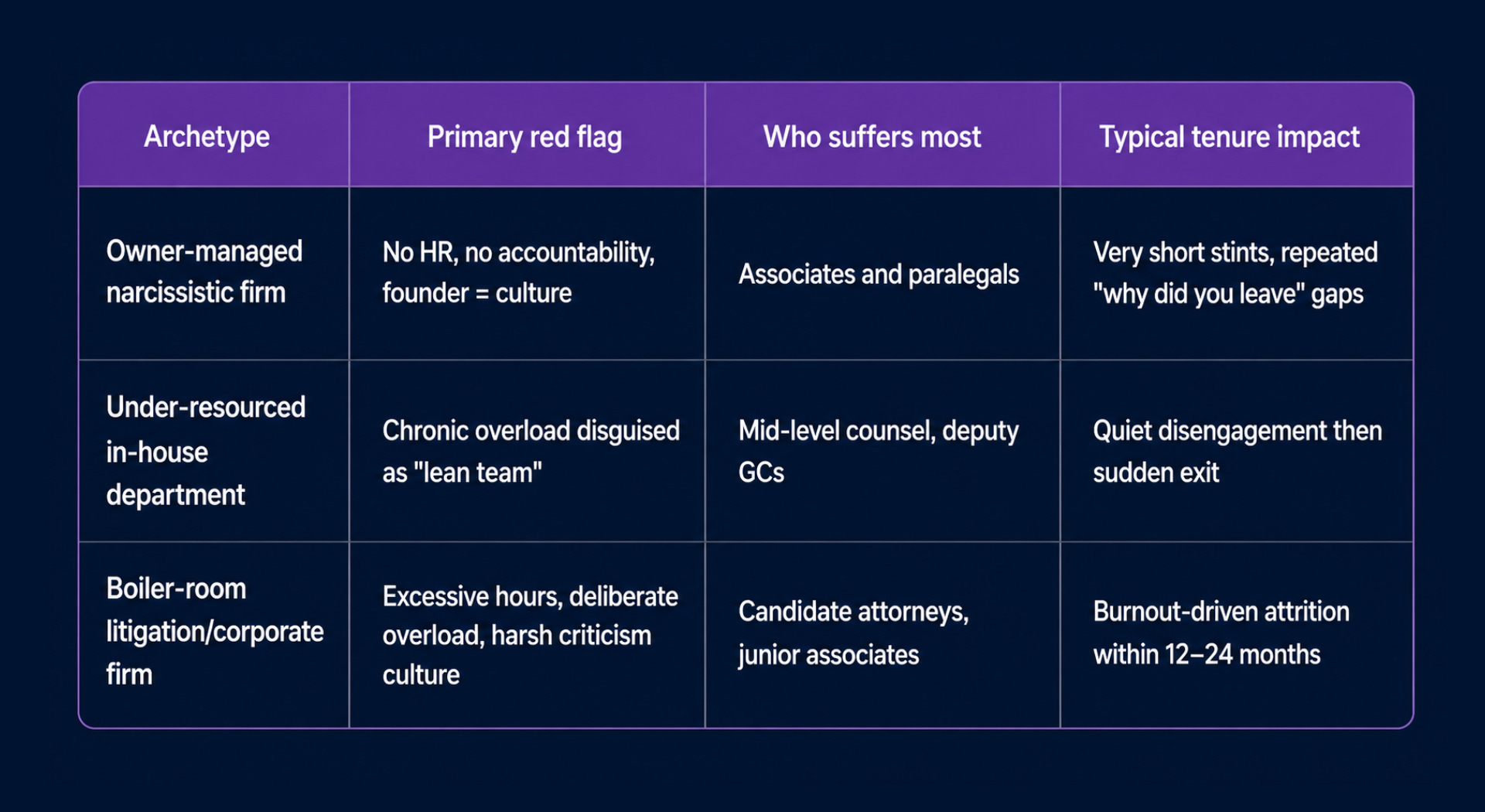
The single most reliable early-warning number is average staff tenure. If a firm or department’s average length of stay is under 18 months, that is not a coincidence or bad luck with hiring.
It is almost always a signal of ownership or leadership dysfunction, since the national legal-sector average itself is already a low 2.6 years.
Anything materially below that baseline should be treated as a serious red flag requiring explanation, not an interesting quirk to be waved away in an interview.
The stakes extend past any one candidate’s CV. Workplace bullying and toxic culture research frames this as a profession-wide problem: repeated exposure to toxic firms erodes confidence, drives talented practitioners out of law altogether, and - per the burnout data - pushes as many as 71% of stressed in-house lawyers to consider leaving the legal profession entirely rather than simply changing employer.
Every capable lawyer who exits the profession because of one bad employer is a loss to the market’s collective skill base, and every toxic firm that survives unscathed because nobody talks about it openly is implicitly rewarded for bad behaviour.
Rigorous, unemotional due diligence - treating an employer search with the same scepticism you would apply to cross-examining a hostile witness - is the only real protection available to individual lawyers in a market where regulatory enforcement against toxic culture remains, even in more mature jurisdictions like the UK, still in its early stages.
For weekly opinion pieces, market reports, jobs, and global event updates, subscribe to our SubStack newsletter.

Rob Green
CEO

Data-driven legal executive search that secures game-changing talent for ambitious law firms.

Global and VIP networking events and business development opportunities for the legal community.

Africa’s leading independent legal market intelligence firm, helping law firms make smart growth decisions.

Our articles offer insight by thought leaders from across legal markets in Africa, Asia and other developing economies.

